Identifying Age
To help monitors accurately document sightings in the field, this guide provides a breakdown of plumage stages and behavioral cues for Bald Eagles.
A comprehensive chart with detailed explanations is available at Avian Report.

First Year
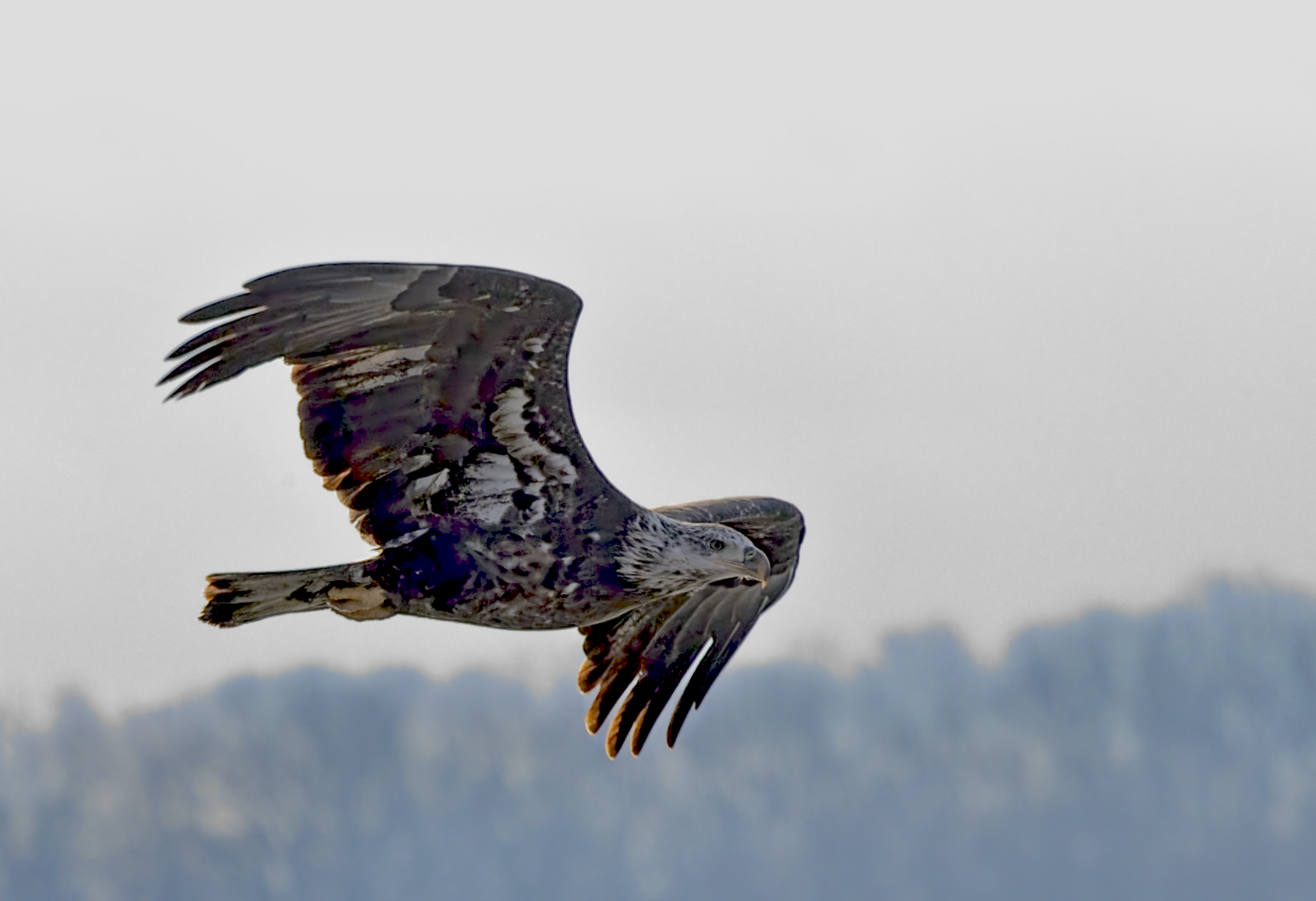
First-year juveniles are the easiest to identify due to their consistent dark coloring.
- Plumage: Almost entirely dark chocolate brown.
- Head & Eye: Dark brown eyes and a solid black/gray beak.
- Wing Shape: Uniformly dark with minimal mottling.
Second Year
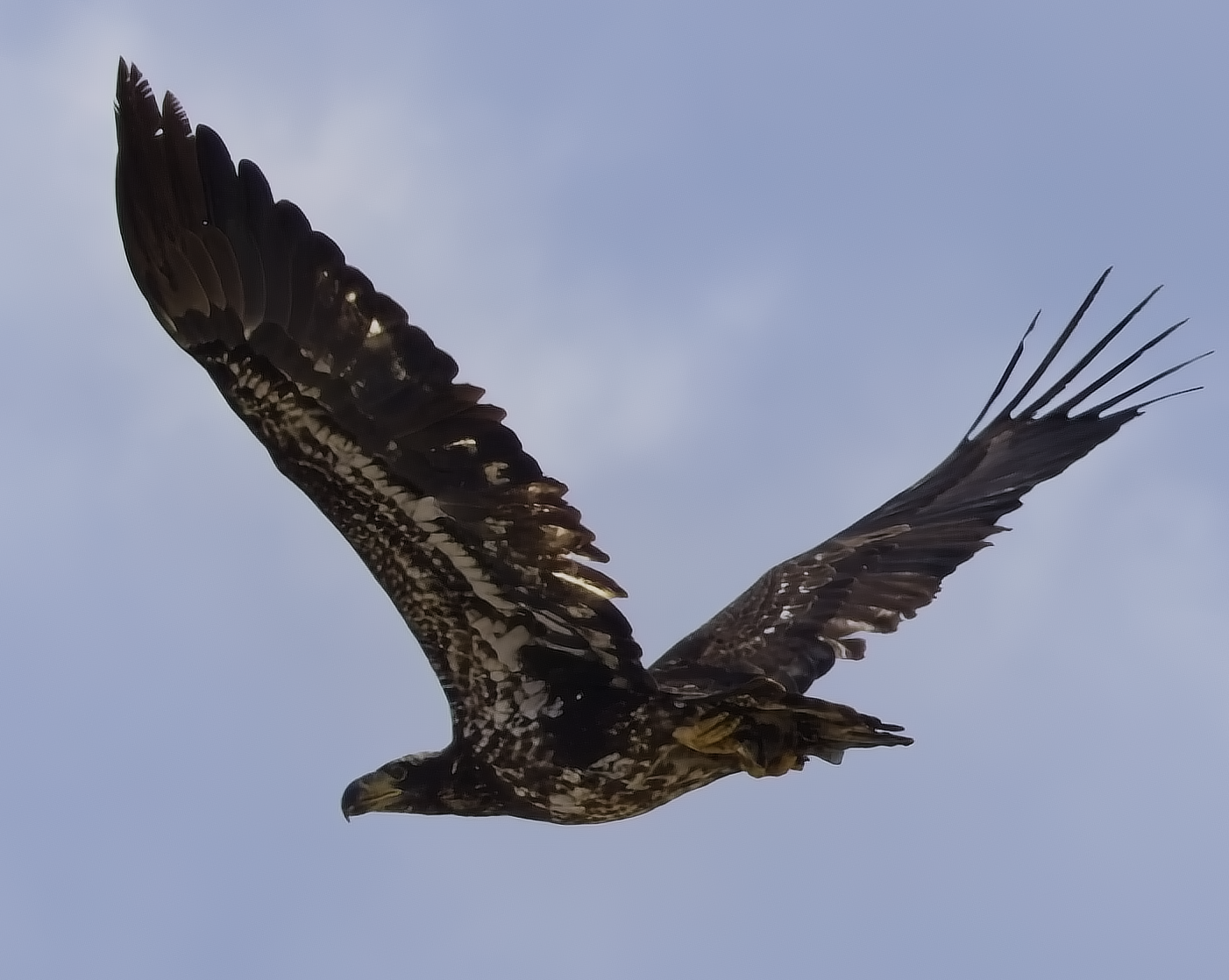
Second-year eagles (roughly 1.5 to 2.5 years old) enter a "messy" transition phase.
- The "Messy" Mottling: Extensive "salt and pepper" white mottling across the underwings, belly, and back. This "tortoiseshell" look is a hallmark of the second year.
- The Head & Eye: The head begins to lighten but often retains a dark "eyestripe" (similar to an Osprey). The eye transitions from dark brown toward pale yellow.
- The Beak: The beak begins to lighten at the base, transitioning from black to a dusky yellow/tan.
- Wing Shape: The trailing edge of the wings may look uneven or "saw-toothed" as the bird molts juvenile feathers for adult-like feathers.
Third Year
Third-year eagles continue the transition toward adult plumage, becoming cleaner but still "dirty" in appearance.
- Plumage: The white mottling becomes more pronounced, and the "belly band" becomes more distinct.
- The Head: The head starts to whiten significantly but remains streaked or "dirty" with brown feathers.
- The Beak: The beak continues its transition to yellow.
Near-Adult (4th or 5th Year)
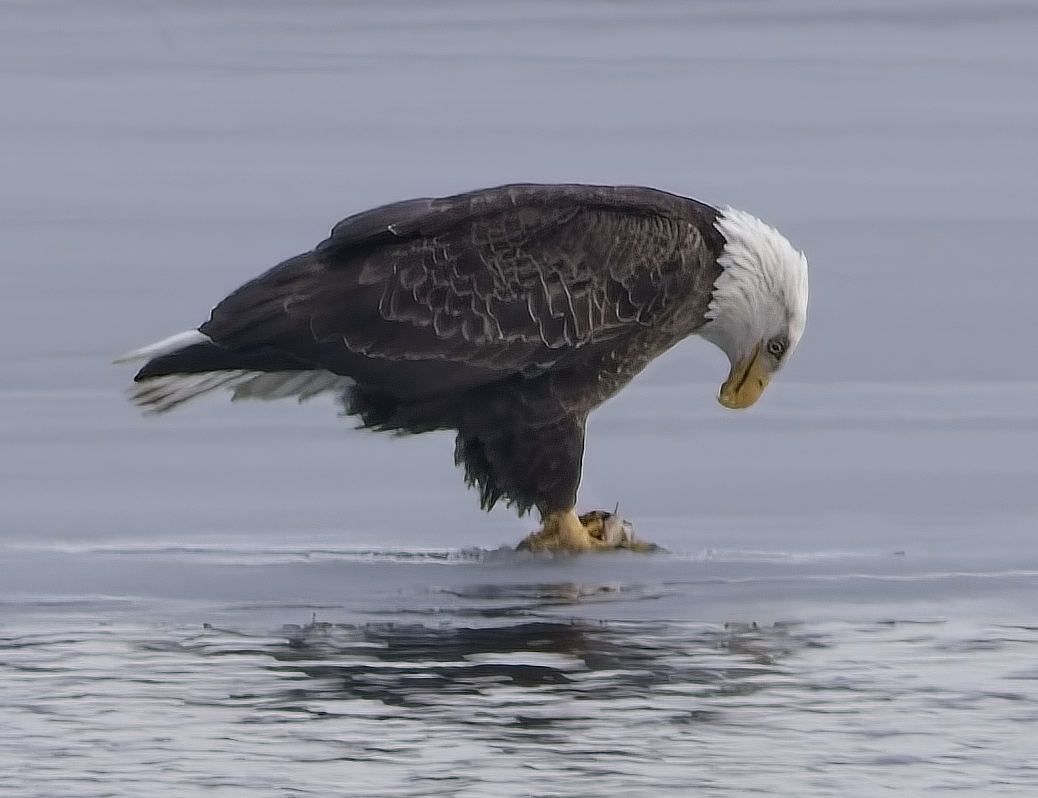
Birds in this stage are nearly indistinguishable from adults at a distance.
- Head & Tail: The head is mostly white, though faint brown flecking or "smudging" may still be visible upon close inspection.
- Beak: The beak is now a solid, vibrant yellow.
- Eyes: The eyes have turned to the piercing pale yellow of an adult.
Adult (5+ Years)
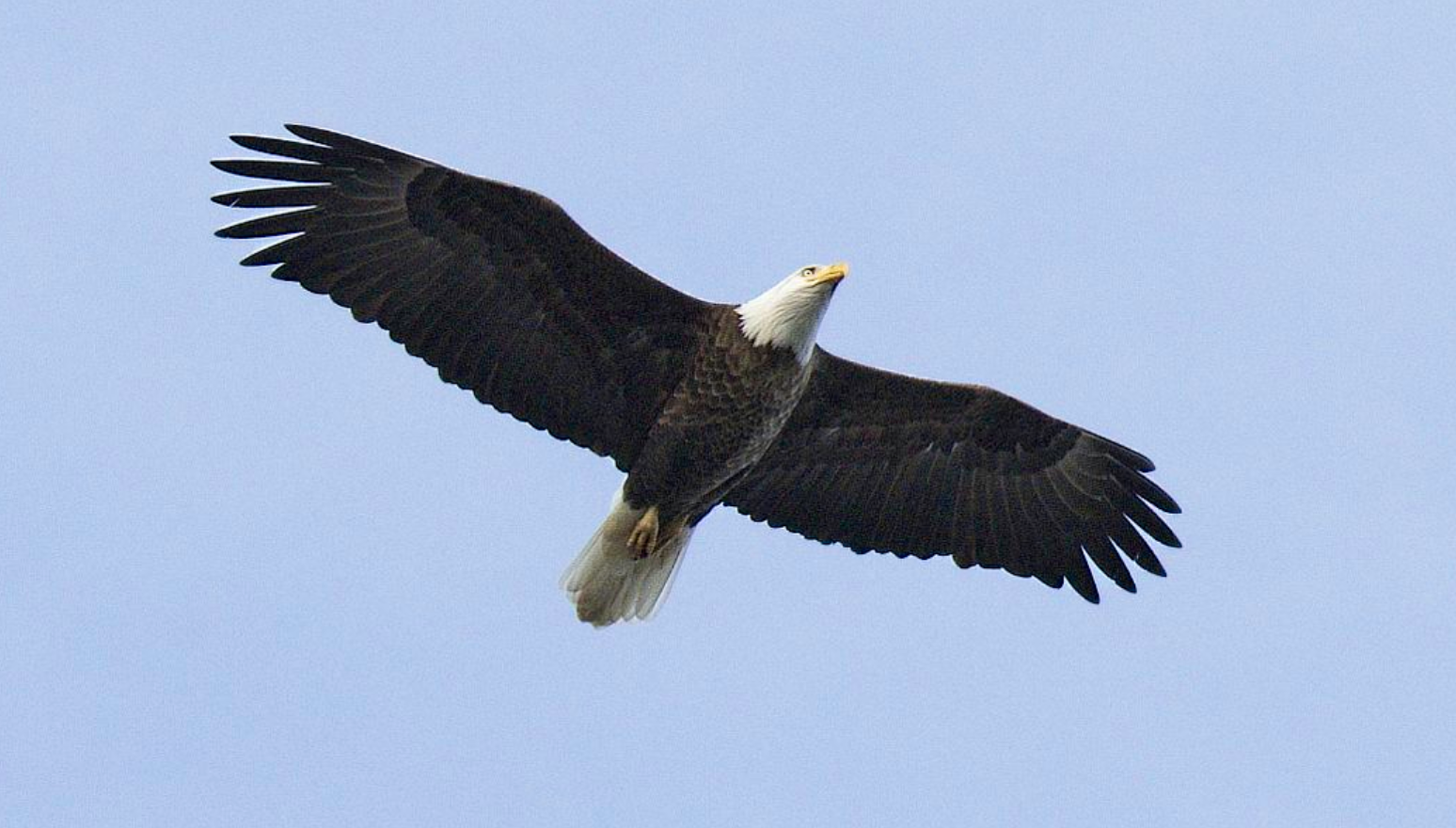
Full adults have achieved their definitive plumage.
- Head & Tail: Iconic, crisp white head and tail with no remaining brown flecks.
- Beak: Bright, solid yellow.
- Eyes: The iris is completely pale yellow.
Identifying the Adults
While male and female Bald Eagles look identical in plumage, there are subtle physical and behavioral differences.
- Size (Dimorphism): Females are roughly 25% larger than males. If both are on the nest together, the female will appear significantly bulkier.
- The Hallux (Rear Claw): In females, the hallux is often longer (over 1 inch) compared to the male.
- Voice: Males typically have a higher-pitched, thinner "squeal," while females have a slightly deeper, harsher "cackle."
Juvenile Plumage Stages
Eaglets change dramatically over their first 12 weeks. Use these visual markers for the Nestling Status column:
- Weeks 1–2 (Neonatal): Covered in light grey "natal down." Wobbly and unable to lift heads.
- Weeks 3–5 (Thermal Down): Thicker, darker grey down. They begin "scooting" around the nest on their hocks.
- Weeks 6–9 (Pin Feathers): Dark brown feathers replace the down, creating a "shaggy" or mottled appearance.
- Weeks 10–12 (Pre-Fledging): Fully feathered in dark brown/black. They begin "branching" (hopping to nearby limbs) and flapping vigorously.
Adult vs. Immature Summary
If you see eagles near the nest without white heads, they are sub-adults. It takes approximately 5 years to reach full adult plumage.
| Age | Primary Characteristics |
|---|---|
| Year 1 | Almost entirely dark brown; dark beak and dark eyes. |
| Year 2 | "Mottled" look; white belly and underwing coverts; "Osprey-like" eye stripe. |
| Year 3 | Head starts to whiten but remains "dirty" or streaked; beak begins turning yellow. |
| Year 4 | Head is mostly white with a few dark spots; tail has a dark terminal band. |
| Year 5+ | Clean white head/tail; bright yellow beak; pale yellow iris. |
Distinguishing from Other Birds
In the field, use these silhouette cues to avoid misidentifying eagles from a distance.
Bald Eagle
- Wing shape: Flat and straight—like long planks.
- Overall look: Big, bulky body with broad wings.
- Flight style: Steady soaring, minimal wobble.
!!! tip "Memory Trick" Think of the Bald Eagle as a "Flying Barn Door."
Turkey Vulture
- Wing shape: Noticeable V-shape (dihedral).
- Flight style: Wobbly, teetering side-to-side; often tilts while riding thermals.
!!! tip "Memory Trick" Think of the Turkey Vulture as a "Drunken Teetering V."
Osprey
- Wing shape: Distinct M-shape (kinked at the wrists/carpals).
- Overall look: Slimmer than an eagle with longer wings.
- Flight style: More active—alternates between flapping and gliding.
!!! tip "Memory Trick" Think of the Osprey as "M for fish-hunter."